Corner Site Fencing in Nelson: The Rule That Catches Homeowners Out
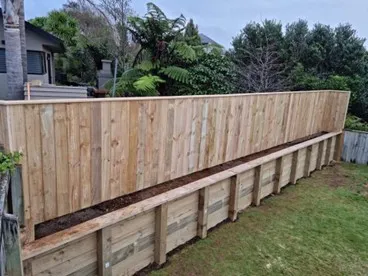
You live on a corner section in Stoke, or Richmond, or Nelson central. You want a fence along both road frontages. You’ve asked a fencing contractor about it and been told there are “corner site rules,” but the explanation was vague and you left the conversation not much clearer than when you started.
The visibility splay rule is one of the more specific pieces of Nelson fencing regulation, and it catches homeowners out regularly, sometimes after the fence is already built. This post covers exactly what it requires, where it applies, and what your options are within it.
Why corner sites have different rules
At an intersection, drivers and pedestrians need to see each other before they arrive at the crossing point. A solid fence built right into the corner of a property removes that sightline. The result is a blind corner: vehicles pulling out can’t see pedestrians, and cyclists approaching from the side road can’t be seen by drivers on the main road.
The visibility splay rule exists specifically to prevent this. It isn’t an arbitrary planning restriction, it’s a road safety requirement, and understanding the reason behind it makes the rule easier to work with.
What the rule actually says
Rule REr.29 of the Nelson Resource Management Plan requires a visibility splay where two road frontages converge on a corner site.
Within that splay, any fence, vegetation or structure greater than 1.0 metre in height must be set back 1.5 metres from the corner.
In plain terms: picture cutting a triangle off the corner of your section, with each side of the triangle 1.5 metres long. Inside that triangle, nothing over 1.0m. Outside it, the standard road frontage rules for your street apply, and those depend on whether your road is classified or unclassified. We’ve set out the full height table in our guide to fence height rules in Nelson and Tasman.
Once you’re past the road frontage and onto a side or rear boundary, 1.8m solid is permitted without restriction.
What the splay means for your fence
Here’s a common Nelson corner site scenario.
A homeowner in Stoke wants a fence along both road frontages for privacy, ideally 1.8m, or as much height as they can get.
What they can achieve under permitted rules:
In the corner triangle: maximum 1.0m. Any material, any style, just nothing over a metre.
On the road frontage beyond the triangle: on an unclassified road, 1.2m solid, or up to 1.8m if the fence is entirely visually permeable. On a classified road, 1.2m solid, or up to 1.8m if at least 50% of the front boundary is visually permeable.
On side and rear boundaries: 1.8m solid, no restriction.
The practical result is a fence that steps: low in the corner triangle, rising to the permitted frontage height once outside it, then potentially rising again to 1.8m on the side boundary. Done well, that step design reads as intentional and looks good. Done without thought, it looks like a mistake.
The step needs planning before the posts go in. The post at the transition from triangle to frontage has to be positioned so the step lands in the right place, and the heights either side of it need to be clean and level. This is layout work, not something to sort out once you’re halfway down the boundary.
Don’t forget the driveway rule
Separate from the road-to-road corner splay, rule REr.40 applies wherever a fence sits within 1.5m of any vehicle access point, yours or your neighbour’s. A visibility splay of 1.5 metres by 2.0 metres must be provided, and within it you need to avoid objects and vegetation over 1.2 metres in height.
Letterboxes and landscaping can sit inside the splay as long as they don’t obstruct visibility to pedestrians.
On a corner site with a driveway near the intersection, both rules can apply to the same stretch of fence, which is a good reason to have someone walk the boundary before anything is ordered. This applies to any property with a vehicle crossing, not just corner sections.
Options within the rules
A continuous low fence along both frontages. The simplest approach. A 1.2m solid timber fence along both road frontages, stepping down to 1.0m inside the corner triangle, is fully compliant. It isn’t 1.8m, but 1.2m solid gives meaningful privacy at street level.
A stepped fence design. 1.0m in the triangle, rising to the permitted frontage height outside it, then 1.8m solid once it reaches the side boundary. This is the most common approach for homeowners who want maximum privacy where they actually use the section. It needs careful design at the post layout stage.
A permeable fence at height. On the road frontage outside the triangle, a visually permeable fence can go to 1.8m. It won’t give you solid privacy from the road, but it creates enclosure and boundary definition at a height a solid fence can’t reach. Timber batten fencing with deliberate gaps, or a slatted aluminium style, both work. The permeability has to be present across the full face.
Planting, with one important caveat. Screening planting is the classic suggestion for getting privacy a fence can’t provide. Be careful with it here. The NRMP defines a fence as including a hedge, and a hedge as a row of shrubs capable of growing over 1.0m whose branches or leaves interleave to form a barrier. A hedge inside the corner triangle is subject to the same 1.0m limit as a fence. Loose, non-interleaving planting that stays clear of the sightline is fine. A solid screening hedge in the splay is not the workaround it’s often described as, and it’s exactly the kind of thing a neighbour complains about.
What happens if you build outside the rules?
Council can issue a notice requiring you to modify or remove a non-compliant fence. On corner sites this is more likely than on a mid-block property, because the splay is directly visible from the road and affects everyone using the street. Neighbours and other road users notice corner site fences, and the risk of a complaint is real.
More practically: a non-compliant fence on a corner site shows up on a Land Information Memorandum, which solicitors obtain in almost every property transaction. A fence flagged on a LIM creates problems at sale time, either requiring remediation before settlement or affecting the price.
Removing and rebuilding a fence because the splay wasn’t followed costs considerably more than getting the design right before the first post goes in.
Does Tasman District Council have the same rule?
Not in the same form. The 1.5m/1.0m splay described here is a Nelson City Council rule from the NRMP, and it doesn’t transfer across the district boundary.
The Tasman Resource Management Plan handles fencing differently. Section 17.1 has no general residential fence height rule at all. Instead it sets specific requirements tied to named Development Areas, and intersection visibility is managed through other mechanisms. If your property is in Richmond, Brightwater, Wakefield or elsewhere in the Tasman district, don’t assume the Nelson measurements apply. Confirm the rules for your specific address and any Development Area overlay before designing a corner fence. The fence height rules guide sets out what the TRMP actually specifies.
If you’re on a corner section, the useful first step is having someone walk the boundary with the rules in hand. Matt can confirm the road classification, mark where the splay actually falls on your section, and lay out a fence that complies and still looks deliberate.
Get in touch to arrange a free site assessment.
Sources: Nelson City Council Building a fence guidance, rules REr.29 and REr.40 of the Nelson Resource Management Plan; Tasman Resource Management Plan Section 17.1. Council rules change, so confirm against the current plan for your address or call NCC’s Duty Planner on 03 546 0357.
Frequently Asked Questions
What is a visibility splay exactly?
A visibility splay is an area kept clear of obstruction so that drivers, cyclists and pedestrians can see each other. On a Nelson corner site it’s the triangle formed by measuring 1.5 metres along each road boundary from the corner point. Within that triangle, no fence, vegetation or structure may exceed 1.0 metre in height.
Can I apply for resource consent to build higher in the splay?
Technically yes, but NCC is unlikely to approve a structure that directly compromises intersection sightlines. The rule exists for road safety, and applications that would reduce visibility at an active intersection face a high bar. If you have a specific reason for needing height there, talk to NCC’s planning team before applying. They can give you an early indication of whether it’s worth pursuing.
Does the splay rule apply to rural or rural-residential properties?
Intersection safety requirements apply across zones, but the specific measurements and height thresholds can differ outside the Residential Zone. Rural roads have different speed environments and sightline requirements from urban streets. Check the rules for your specific zone rather than assuming the residential figures apply.
What if my existing fence in the splay is over 1.0m?
It may have existing use rights. In Nelson, fences lawfully established before 30 June 2012 can be replaced like for like without a resource consent. A pre-existing non-complying fence is generally tolerated as long as you don’t modify or extend it. If you replace it, you’d normally need to bring it into compliance. If a neighbour or the council has raised it, take advice on whether you’re required to act.
Does the splay rule apply to gates as well as fences?
Yes. A gate is a structure for planning purposes and is subject to the same 1.0m limit within the splay. If the gate needs to be taller for security or privacy, position it outside the triangle, set back far enough from the corner that it clears the splay entirely. The same thinking applies to a gate near a driveway, where the separate 1.5m by 2.0m vehicle access splay comes into play.